Join us on Saturday, June 3 at the Elk Pass Trail Head in Peter Lougheed Provincial Park between 9am and 4pm in celebration of BC Trails Day!
While this event is being held in Alberta, Peter Lougheed Provincial Park is an important access point to the GDT and trails and parks in BC. Volunteers will be on hand to answer questions and share our experiences on the trail. For those thinking about hiking the GDT (in whole or in part) and wanting to learn more, or supporters who want to stop in to say hi, all are welcome. We’ll also have details on nearby portions of the trail that pass through Elk Lakes and Height of the Rockies Provincial Parks.
We love the trails that make up the GDT and during the last few years more than ever we’ve realized how lucky our community is to have such amazing trail networks available to us. It’s thanks to the volunteers and trail caretakers that we all get to enjoy the beautiful wild spaces in our backyard.
Communities, groups, and outdoor enthusiasts all over BC (and occasionally in Alberta too!) are organizing events to celebrate beautiful trails and show their appreciation for all the work done by volunteers and local trail caretakers in partnership with the Outdoor Recreation Council of BC. If you’re not near Peter Lougheed check out some of the other great events going on.
The concept began in 2003 while two hikers (Dan Wallace and Wayne Marshall) were walking the Great Divide Trail (GDT) when it just disappeared. The pair had spent many of the previous summers hiking The Trail and decided losing The Trail was a sign – it was time to ‘give back’. The need was obvious – the existing Trail required maintenance. These Trail hikers pivoted to become Trail maintainers.
1996 Dan and Wayne – first GDT trip
With no experience, no money, no tools or equipment – only an idea, the pair spent the winter of 2003 researching and reaching out which culminated in the organizing and implementation of a Trail maintenance ‘trip’ in 2004. The intention was to interest like-minded people in volunteering to come on a few-day trip to camp on the Great Divide Trail and be willing to work. This would include using specialized tools and equipment to cut and remove deadfall, repair The Trail tread, clear the corridor, blaze The Trail and connectors, and replace or build log bridges.
2004 Trail maintenance
The 2004 Trip was unique:
It was the first of many annual trips reviving the Great Divide Trail that was built in the mid 1970’s.
It was scheduled to be ten days, two weekends and the week in-between.
It had ‘organization’ support (Alberta Wilderness Association), some financial assistance from a private donor and a sponsor (Stihl).
Trail maintenance tools and equipment were borrowed.
It had a ‘camp’ set up near Perky Perkinson’s cabin in the Cataract Creek Valley.
Since the campsite had no road access, an outfitter with pack horses was used to transport the required camp gear, tools, equipment, and supplies.
Ten volunteers and a horse were the crew. They backpacked their own personal gear to and from the camp.
A cook planned the breakfast, lunch, and dinner menus; purchased the food, prepared and cooked the meals over a campfire along with a two-burner camp stove.
Perky Perkinson’s Cabin 2004
Crew 2004
It is the Longest Running GDTA Trip
The success of the inaugural Trip led to subsequent annual Trail maintenance trips. These were usually held at different locations along The Trail with some being for specific purposes, for example bridge building.
These early trips introduced hiking enthusiasts not only to the beauty of the Great Divide Trail but also to its remoteness and ruggedness. It gave them an opportunity to not only hike but also work on The Trail therefore appreciating the efforts of those Trail maintainers and builders who came before them. These trips initialized a community of like-minded people. Many of these came back many times to become veterans acquiring skills and expertise which they willingly shared with new recruits. Some were so motivated by their experience they continued to give back by becoming Great Divide Trail Association (GDTA) Board and/or Committee members.
These trips continued, with the latest being held in 2022, however there were some interruptions along the way including a forest fire, a flood and a pandemic.
It Evolved
Over the years, with increasing membership, sponsorship (funding) and experience, the annual Trip developed, matured. and grew. The first Trip was born from a perceived need and has grown into a vital component of what the GDTA does. Every Trip was an opportunity to learn through experience and feedback from volunteers with the intention of making the event more efficient, enjoyable, comfortable, and memorable.
The pair of lost hikers – Dan and Wayne, morphed into a group – the Friends of the Great Divide Trail. It was highly recommended the group not be formally recognized for political reasons however, it would not last. One year, while attempting to get a Trip permit, a pointed comment from a government agent told the group “to grow up” which inspired the reactivation of the Great Divide Trail Association in 2013.
The appetite of thru-hikers and new members encouraged the creation of the GDTA website and more. Social media and the increased workload revealed the need for committees. With the formation of GDTA committees, the Trip became the responsibility of the Trail Building and Maintenance Committee (TBMC) always with a desire to improve/enhance Trip working and living conditions. Trip leadership roles and responsibilities were identified: Trip Coordinator, Trip Manager, Safety Officer, Camp Manager to name a few. Trip participants signed up for camp positions/tasks. Thus everyone contributed.
The ‘realignment’ of The Trail from the British Columbia side to the Alberta side, creating the High Rock Trail, resulted in big Trip changes one of which was converting from Trail maintenance to Trail building. The TBMC decided one Trip a year was not sufficient to construct the new Trail in a reasonable amount of time therefore more trips were added. As a result, in 2015, the original Trip became named – The Signature Trip; referring to “something that serves to be set apart or identify” (Merriam- Webster). It is important to note the Signature Trip birthed the many ‘specialized’ trips that are common today.
What started with ten adventurous people offering to maintain the Trail is now a Signature Trip with twenty energetic Trail builders and supporters.
In the beginning people sat on logs around the campfire. Now, with transport, volunteers can relax in their own comfortable lawn/camp chairs while sharing their stories.
2009 – Logs around the campfire
Transport
2019 – Campchairs around the campfire
If one felt a need to wash/bath, a clean mountain lake or a pool in a cold stream was usually available (it was also a fridge).
Clear mountain lake – brrrrrrr……..
Cold streams make good refridgerators
Now one can choose a warm shower (solar heated) in a private, tarp-walled, stall.
Solar heated shower bags
Shower
Since water is a necessity for drinking and food preparation, the camp was normally located near a stream enabling volunteers to haul water in barrels and pails. Now a solar panel charges a battery powered electric pump providing ‘running’ water almost to camp – still a work in progress.
A filtering system was also devised for drinking water.
Left – Bringing water to the campsite Right – 2022 – Water filtration system to go with the new water pump
Volunteers slept on foamies in personal tents that were initially backpacked in. Now with ATV support some choose to sleep in larger tents allowing a person to stand to put on work clothes or bring a folding cot.
Large tent courtesy of ATV support
And cot also hauled in on the ATV
When it rained, campers huddled under tarps tied to the trees, next it was a car shelter, then it was two. Now people meet and dine comfortably in walled, heated, canvas outfitters tents.
2010 – Commons shelter
2011 – Commons shelter
2018 – Commons shelter
2022 – Commons shelter
From day one, feeding the Signature Trip crew well, was a priority. The cook planned menus, purchased the food which was organized and packed for shipping to the campsite.
Shopping for food (top); Organizing and packing food (bottom)
Initially cooking equipment was primitive but effective and efficient. The cook and helpers prepared the food to be cooked on Coleman stoves and the campfire.
2009 – Burgers grilled over the campfire
2009 – Cooking on the Coleman stove
Meals on the campfire
Over time, the Colemans (the stoves, not the people) were replaced with a heavy-duty propane camp stove, and then two.
2010 – The heavy-duty propane stove
2014 – Two heavy-duty propane stoves
And then supplemented with a BBQ to keep the prepared food warm. One year, a beef roast was cooked in the BBQ.
Full blown propane barbeque
In two of the latter years, workers had the fortune of enjoying their meals created by a backcountry chef who used chaffing pans.
2021 – Meal prepared by the chef
And of course, steaks by Lianne and Dan.
2009 – Yummy steaks over the fire (top) 2022 – Personalized steaks on the barbeque (bottom)
In the early days, food was eaten on ‘paper’ plates with whatever utensils each of us brought with us. Today, camp drink and food are provided in/on re-useable cups and plates along with real utensils.
2022 – Real plates, cups, forks, knives, etc.
Some participants have more of a food ‘experience’.
Digging right in, Ah, to be young again…
An outdoor portable/folding kitchen pantry provided a workspace, a storage area for pots and pans, and even a sink.
2010 – Portable outdoor kitchen
Of course, what goes in must come out. As the book (now in its 4th edition) says, people had to learn “How to Shit in the Woods”. Over the years, the latrine also advanced. From a cat hole with a strategically placed log, to several logs to give elevation, to 2 x 4’s appropriately and securely stacked topped by a toilet seat, to a luxury commode complete with a roof, and all with an open-air view. The latrine is a defining structure for the Signature Trip.
Commode evolution
It is a Learning Opportunity
Since its inception, the Signature Trip was designed to be a learning opportunity. The Trip, with its experienced leadership, offered knowledge and safety for people who may never have backpacked and camped in the bush overnight. Participants, with the guidance of mentors, experienced the rigours of setting-up and taking-down the camp. At the end of a hard day’s work, volunteers tasted the nutritious meals that they did not have to plan, purchase, or cook even though they helped prepare or cleaned up.
The Trip supplied unfamiliar tools along with the training and opportunity to learn their safe use, some even being taught how to use trail building and maintenance power tools. A few seized the opportunity to ‘scout’ the new Trail route.
2014 – Trail maintenance tools
At the nightly campfire, after a traditional knot tying session, volunteers learned, from others, about their hiking adventures all over the world. As an experiment at the 2022 Signature Trip, participants also had the chance to discover where they were camping by interpreting a topographical map and competing against other teams to locate geocaches.
Knot tying session
It Builds Community
The Signature Trip typically attracts, due to the reasons above, participants that are ‘new’ to the Great Divide Trail. They may have heard of it, or even walked on parts of it. Most have little to no experience backpacking and camping in a remote location but are open to the possibilities.
Some volunteers return to the Signature Trip many times. Signature Trippers discover ‘community’; they find like-minded people with stories and experience to share, outdoor enthusiasts wanting to give back, adventurists who are looking for excitement and a challenge. Instructors and learners. Knowledge and skill. Practice and expertise.
Many first timers chose to re-live the exhilaration and come back on this or other types of GDTA trips thereby creating a community supporting each other to achieve a common vision.
It Has Tradition
Since 2004, what is now called the Signature Trip has been held almost every year, with some exceptions. The Signature Trip introduced many to the Great Divide Trail, its supporters and promotors, its community, its sponsors. The Signature Trip has become a tradition for the Great Divide Trail Association.
At the conclusion of the Signature Trip on the way back to Calgary it has become a ritual for the tired and dirty volunteers to convene at the Black Diamond Bar and Hotel pub to celebrate their Trip achievements.
2010 – Annual after party at Black Diamond Bar and Hotel pub
Is it a Brand?
If an organization’s ‘brand’ has these features: memorable, defining, unique, long lasting and mass recognition perhaps the Signature Trip has become the brand of the Great Divide Trail Association.
Additional trail construction continues as we fine-tune the High Rock Trail resulting in a few minor route changes.
The new Window Mountain Lake Bypass was completed last summer, creating an equestrian friendly route or shortcut for hikers wishing to skip the lake (which you definitely shouldn’t).
Marmot Lake campground has been added to the GDT campground list. The campground is 700m off the main trail next to a beautiful alpine lake.
Section C:
Elk Pass Trailhead Resupply will continue this year thanks to Nicole Sharpe who has again generously offered to deliver resupply boxes to the Elk Pass Trailhead in Peter Lougheed Provincial Park. The cost is $25 for GDTA members or $40 for non-members. Contact Nicole through Facebook or at nicole.d.sharpe@gmail.com to book your delivery service and receive mailing instructions. Once you’ve paid the fee, Nicole will give you her Zoleo satellite communicator number in case on-trail communication is needed.
Aster Lake campground (on the Northover Ridge alternate route) will be closed this summer for refurbishment.
Egypt Lake campground will be closed starting August 1st during work to replace the Egypt Lake Shelter.
Section D:
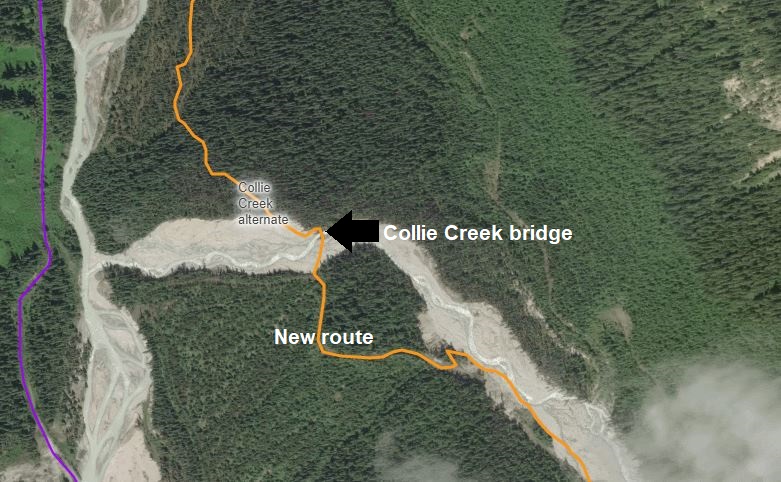
Further improvements to the Collie Creek alternate route took place last summer, including maintenance throughout the existing trail, restoration of an additional 1 km of trail at the south end of the route, and the construction of a bridge over Collie Creek, making it highly recommended this year. Note the new (flagged) route to access the bridge. At the north end of the Collie Creek alternate, a forestry bridge should provide safe passage to continue the GDT on the other side of the Blaeberry River. Be warned that the forestry bridge is slated for removal which could occur as early as mid-August 2023 and the Blaeberry River is generally unfordable prior to September.
Section E:
The Six-Passes Alternate Route is closed again this year to all overnight random camping but is open to random day use activity.
The three campgrounds on the Maligne Pass Trail previously available online as ‘Maligne Pass North’ (Mary Vaux, Mary Schäffer, Trapper Creek) are listed in the online reservation system separately, 1 site per night at each campground.
Section F:
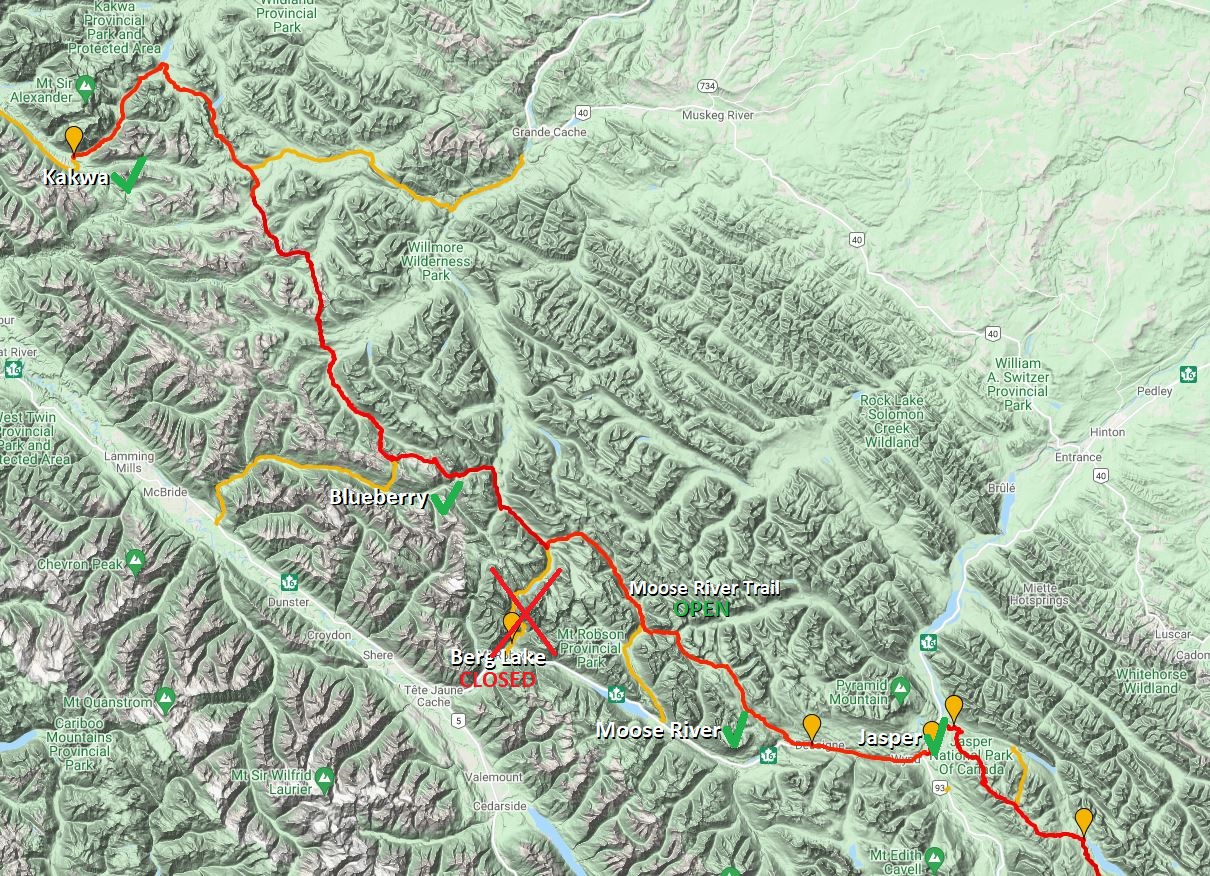
The Berg Lake Trail remains closed and it will not open this summer so hikers should plan accordingly when arranging resupply or exiting the trail.
The Moose River Trail remains open so hikers can connect with Section G via Moose Pass.
Exiting via the Moose River Trail to Highway 16 is another option.
Section G:
With the closure of the Berg Lake Trail, exit or resupply (with support) via the Blueberry Trail are good options.
Robson Valley Adventures Unplugged will not be offering shuttle services to the Kakwa and Blueberry trailheads this summer.
Following the past two years’ successful maintenance trips in the Jackpine valley, the entire trail has been cleared! All of the old trail has been discovered and restored which means the trail now fords the Jackpine River more frequently (20 times). In normal water level conditions these fords are easy and only knee deep but hikers should be aware. In higher water conditions, it is an option to avoid most of the fords by bushwhacking along the original side of the river to cross less frequently.
The Walker Creek FSR continues to be in rough shape and BC Parks lists Walker Creek FSR as closed at km 37 due to unsafe road conditions. The road remains accessible beyond that point for those with high clearance 4WD vehicles willing to drive the very rough and overgrown road to from the Bastille Creek trailhead.
As an alternative to the Walker Creek FSR, an eastern exit route from Kakwa Lake has been added. The route runs 26 km on an old tote road plus another 6 km on an old trail to reach the 4WD trailhead at Deadhorse Meadows in 32 km. The walking is generally good, but where boggy sections exist look for singletrack detours that skirt around. From Deadhorse Meadows it is a further 18 km to the 2WD trailhead at Lick Creek. If you don’t have a ride arranged, continue a further 15 km to the popular Two Lakes Recreation Area where your search for a ride should be more fruitful.
Winter conditions are here. Snow is falling and accumulating on the GDT so expect wet, icy and slippery trail conditions. Boots, hiking poles, snow cleats or snowshoes are recommended. Temperatures are below freezing, so be prepared for winter conditions and short days when travelling into the backcountry this winter.
Remember that the GDT is not designed for snow travel and is not maintained in the winter. When the trail is covered in snow, finding it may be impossible so excellent navigation skills are required. Hiking or skiing on the GDT when it’s snow covered means exposing yourself to potential avalanche risk. In many places, it’s unwise to travel the trail during these conditions. While planning your hike, research snow conditions and check out the Canadian Avalanche Centre for the latest avalanche bulletins.
TRAIL CLOSURES AND NOTICES:
CLOSURE – Mount Robson Provincial Park: The Berg Lake Trail will remain closed for repairs during the 2023 season, except for the first 7 kilometres from the parking lot to Kinney Lake. 14 sites at Kinney Lake Campground will open for reservations on a four-month rolling window at 7:00am on February 1, 2023.
SEASONAL CLOSURE – Jasper National Park: The GDT is closed from Four Point Campground (e15) to Trapper Creek (e24) and from Moose Pass (f15) to Bess Pass (g3) from November 1, 2021 to May 15, 2022, to prevent winter trails from facilitating an unnatural level of predator access to threatened woodland caribou.
CLOSURE – Forks campground in Peter Lougheed Provincial Park is closed due to construction.
CLOSURE – Egypt Lake and Bryant Creek shelters are closed until further notice due to construction.
ACCESS:
Winter conditions exist on many mountain highways and roads. Roads can be snowy and icy so check for the latest conditions before you travel and carry chains and/or winter tires. For more information, check out Alberta 511 and Drive BC.
Highway 40 is seasonally closed from Peter Lougheed Provincial Park to Highwood House beginning December 1.
Forestry Trunk Road 940 is seasonally closed south of Cataract Creek and northwest of Plateau Mountain Road beginning December 1.
A Kananaskis Conservation Pass will be required for all vehicles visiting Kananaskis Country and provincial sites in the Bow Valley Corridor. The pass is not required for people arriving without a vehicle on foot, horseback or bicycle.
Highway 1 road construction 4 km east of Golden – Extended 24 closure until December 2022. Detour via Highway 93S and Highway 95.
Walker Creek FSR is inaccessible to regular vehicles during the winter.
The trail building and maintenance committee, chaired by Dave Hockey, had a very busy and productive summer. Several trail crews answered the needs, both planned and unplanned, of Sections B, D, E, F and G. All told, it amounted to:
117 total individual trail work volunteers
6,950 volunteer hours building or maintaining trail
4 km of new trail built and
9 km of trail rebuilt or rerouted over
106 km of tail maintenance
3 brand new bridges
Trail crews kicked off the trail building season at the end of June, starting with the first of many trips to the High Rock Trail. There were exactly 7 trail building camps on the HRT, plus a special project to build the Allison Creek bridge, and one to do some additional clearing.
Allison Creek bridge.
Speaking of the High Rock Trail, this summer was the official opening of the High Rock. To celebrate the past 7 years of its creation, we held an event at Chinook Lake Recreation Area in Coleman Alberta. The Pass brewery in Blairmore even named a beer after the trail for the occasion – the High Rock Mango Blonde.
Trail Trip #3 crew hard at work on new switchbacks along the High Rock Trail.
GDTA President Doug Borthwick takes a break from his work on Trail Trip #6, to chat with long time GDTA volunteers, Deb and Jeremy as they hike the HRT.
In addition to all the trips to the High Rock Trail, we had many other successful trips.
First was the successful completion of the Collie Creek Bridge!
The Collie Creek bridge in Section D needed more enhancements.
The Oldman Bridge Building Trip where the crew built a brand new bridge on the Oldman River as well as trail clearing and maintenance to the new bridge site.
Brand new Oldman bridge.
The Colonel Creek Clearing Trip was in collaboration with BC Parks and Backcountry Horsemen of BC to clear the hundreds of deadfall that have resulted from a previous burn in Mount Robson Provincial Park.
The Jackpine Trip cleared 15 km of very tight bush, so that now hikers can enjoy a beautiful river walk through.
The Jackpine trail crew on the move.
David Thompson Heritage Trail Clearing which cleared a temporary route through two avalanche paths, clearing over 200 deadfall to Lambe Creek.
The David Thompson Heritage Trail, part of Section D, continues to cook up new challenges for GDTA trail crews. This new avalanche along the Blaeberry River took out trail.
A GDTA Trail Crew made an unplanned Trail Trip to clear a path (lower right) through the avalanche debris.
A collaboration trip with Friends of Jasper National Park worked on clearing bush in Maligne Valley with hand tools.
Maligne Valley Trip Crew starting out on the trail to camp. Left to right – Mark, Chris, Keiko, Andre, Al, and David.
Trip leader Tasha Shakotko had the below to share on her experience on trail building and clearing trips.
There’s something wonderful to be said for the amazing people who volunteer for the trail building and clearing trips. A group of people, likely meeting for the first time, coming together to venture into the backcountry. A common goal of wanting to give back, support the trail and it’s users; creating a bond and allowing friendships to form quickly. The excitement of starting out on trail, helping to make packs feel lighter and the miles to camp go quickly. Lively conversation filling the air as everyone gets to know each other a little better. Swapping stories about past volunteer trips and hiking adventures. The camaraderie deepening as everyone digs into the work, literally and figuratively. Working side by side – the satisfaction at the end of the day of a job well done shared equally by all. Yes, the trail improvements are the goal, but the reward is the time spent after the work is done. Reminiscing on the days efforts already starting around the circle of stoves as dinners are made. As the end of the trip and the return to normal life nears, the crew knows it lefts its mark on the trail – but as it always seems to do, the trail has also left its mark in the hearts of the volunteers. They’ll look back on their time with increasing fondness – allowing time to add a rosy tint to the mosquitoes, blisters, and dehydrated meals that filled their days.
Maligne Valley Trip Crew starting work on the trail. Left to right – Tasha, Mark, Al, Chris, Andre, Keiko, and David.
Fall colours are here and so is the snow! Expect trails to be snow covered and wet, slippery and muddy conditions. Nighttime and early morning temperatures are below freezing, so be prepared for cold temperatures, morning frost and shorter days when travelling into the backcountry this fall.
TRAIL CLOSURES AND NOTICES:
COVID-19: We encourage everyone who spends time on the GDT this year to do so safely and continue to do your part to limit the spread of COVID-19. Hikers with plans on the GDT should pay close attention to provincial and local health restrictions as they evolve and be prepared to make changes to your plans in order to comply with these restrictions.
CLOSURE – Mount Robson Provincial Park: Due to ongoing assessment and construction following the significant damage from last year’s flooding, the entire Berg Lake Trail, including the parking lot, will be closed throughout 2022 for all activities and for both day and overnight users. Mount Robson Visitor Centre has temporarily suspended its resupply package service. The Moose River Trail is open, giving GDT Hikers 4 options to use as the GDT northern terminus other than the Berg Lake Trail: 1. Jasper 2. Moose River 3. Blueberry 4. Kakwa
ELK RUTTING SEASON: It is elk rutting season until mid-October. Warning signs that read “ATTENTION – Elk Mating” have been posted at areas where elk herds often gather. Be aware that bull elk become extremely aggressive during rutting season so keep at least 30 metres away from all elk and never get between a male and female elk.
BEARS: It’s pre-hibernation feeding season for black and grizzly bears which increases the chances of running into a bear on the trail. It is easy to surprise a bear that is focussed on feeding so make noise while hiking in bear territory. Be alert, make noise, carry bear spray and if you see a bear, back away slowly and leave the area.
CLOSURE – Jasper National Park: 6-Passes Alternate Route is closed to all overnight random camping but is open to random day use activity.
CLOSURE – Forks campground in Peter Lougheed Provincial Park is closed due to construction.
CLOSURE – Egypt Lake and Bryant Creek shelters are closed until further notice due to construction.
ACCESS:
A Kananaskis Conservation Pass will be required for all vehicles visiting Kananaskis Country and provincial sites in the Bow Valley Corridor. The pass is not required for people arriving without a vehicle on foot, horseback or bicycle.
Highway 1 road construction 4 km east of Golden – No daytime stoppages until September 26, 2022. Prepare for delays and weekday nighttime closures (10pm-7am). Extended 24 hour closure will be in effect beginning September 27. If necessary, detour via Highway 93S and Highway 95
BC Parks lists Walker Creek FSR as closed at km 37 due to unsafe road conditions, but the road remains accessible beyond that point for those with high clearance 4WD vehicles willing to drive the very rough and overgrown road all the way to from the Bastille Creek trailhead.
Cooler temperatures, shorter days and the first snowfall and frost are signs that summer in the mountains is winding down. Trails are generally still in good condition but expect some wet and muddy sections following periods of rain or snow.
TRAIL CLOSURES AND NOTICES:
COVID-19: We encourage everyone who spends time on the GDT this year to do so safely and continue to do your part to limit the spread of COVID-19. The GDTA continues to support single-day hikes or horseback rides on the GDT and longer (weekend or multi-day) trips where trails and trailheads are open. Be aware that some facilities and services along the GDT may be closed or limited. Hikers with plans on the GDT should pay close attention to provincial and local health restrictions as they evolve and be prepared to make changes to your plans in order to comply with these restrictions.
CLOSURE – Mount Robson Provincial Park: Due to ongoing assessment and construction following the significant damage from last year’s flooding, the entire Berg Lake Trail, including the parking lot, will be closed throughout 2022 for all activities and for both day and overnight users. Mount Robson Visitor Centre has temporarily suspended its resupply package service. The Moose River Trail is open, giving GDT Hikers 4 options to use as the GDT northern terminus other than the Berg Lake Trail: 1. Jasper 2. Moose River 3. Blueberry 4. Kakwa
ELK RUTTING SEASON: It is elk rutting season until mid-October. Warning signs that read “ATTENTION – Elk Mating” have been posted at areas where elk herds often gather. Be aware that bull elk become extremely aggressive during rutting season so keep at least 30 metres away from all elk and never get between a male and female elk.
BEARS: It’s pre-hibernation feeding season for black and grizzly bears which increases the chances of running into a bear on the trail. It is easy to surprise a bear that is focussed on feeding so make noise while hiking in bear territory. Be alert, make noise, carry bear spray and if you see a bear, back away slowly and leave the area.
CLOSURE – Jasper National Park: 6-Passes Alternate Route is closed to all overnight random camping but is open to random day use activity.
CLOSURE – Forks campground in Peter Lougheed Provincial Park is closed all summer due to construction.
CLOSURE – Egypt Lake and Bryant Creek shelters are closed until further notice due to construction.
DAMAGEDBRIDGE – Chown Creek bridge (g2) was damaged by extreme flooding last year and only a portion of the bridge remains. If the creek is impassable, NOBO hikers can bushwhack in the forest on the south bank of Chown Creek and reconnect to the GDT about 3 km upstream. SOBO hikers should not ford Chown Creek.
FIRES: Conditions have improved but smoke from wildfires continues to impact many sections of the GDT. If you must have a campfire in the backcountry, ensure you follow the rules.
ACCESS:
A Kananaskis Conservation Pass will be required for all vehicles visiting Kananaskis Country and provincial sites in the Bow Valley Corridor. The pass is not required for people arriving without a vehicle on foot, horseback or bicycle.
Highway 1 road construction 4 km east of Golden – No daytime stoppages until September 26, 2022. Prepare for delays and weekday nighttime closures (10pm-7am). Extended 24 hour closure will be in effect beginning September 27. If necessary, detour via Highway 93S and Highway 95
BC Parks lists Walker Creek FSR as closed at km 37 due to unsafe road conditions, but the road remains accessible beyond that point for those with high clearance 4WD vehicles willing to drive the very rough and overgrown road all the way to from the Bastille Creek trailhead.
Wildflowers are blooming and berry season has started! Most of the GDT is now snow free with the exception of some lingering snow patches at higher elevations. Valley bottom trails at lower elevations are mostly dry.
TRAIL CLOSURES AND NOTICES:
COVID-19: We encourage everyone who spends time on the GDT this year to do so safely and continue to do your part to limit the spread of COVID-19. The GDTA continues to support single-day hikes or horseback rides on the GDT and longer (weekend or multi-day) trips where trails and trailheads are open. Be aware that some facilities and services along the GDT may be closed or limited. Hikers with plans on the GDT should pay close attention to provincial and local health restrictions as they evolve and be prepared to make changes to your plans in order to comply with these restrictions.
CLOSURE – Mount Robson Provincial Park: Due to ongoing assessment and construction following the significant damage from last year’s flooding, the entire Berg Lake Trail, including the parking lot, will be closed throughout 2022 for all activities and for both day and overnight users. Mount Robson Visitor Centre has temporarily suspended its resupply package service. The Moose River Trail is open, giving GDT Hikers 4 options to use as the GDT northern terminus other than the Berg Lake Trail: 1. Jasper 2. Moose River 3. Blueberry 4. Kakwa
CLOSURE UPDATE – Jasper National Park: 6-Passes Alternate Route is closed to all overnight random camping but is open to random day use activity.
CLOSURE – Forks campground in Peter Lougheed Provincial Park is closed all summer due to construction.
CLOSURE – Egypt Lake and Bryant Creek shelters are closed until further notice due to construction.
DAMAGEDBRIDGE – Chown Creek bridge (g2) was damaged by extreme flooding last year and only a portion of the bridge remains. If the creek is impassable, NOBO hikers can bushwhack in the forest on the south bank of Chown Creek and reconnect to the GDT about 3 km upstream. SOBO hikers should not ford Chown Creek.
OPEN – The new High Rock Trail is open while trail crews continue working on it this summer, so be mindful and say hello!
FIRES: While wildfires aren’t burning close to the GDT, fire bans or advisories are in effect along some of the GDT. Campfires are banned in Alberta from the US border to the Oldman River including Waterton Lakes National Park and in BC from Akamina Pass to Howse Pass, not including Kootenay and Yoho national parks. If you must have a campfire in the backcountry, ensure you follow the rules.
CREEKS: Rapid snow melt during this time of year results in high water levels and potentially dangerous creek crossings, particularly later in the day. Attempt to ford larger creeks early in the day when water levels are lowest.
BEARS: It’s berry season! Berry bushes border trails, roads and campgrounds on the GDT, and black bears and grizzly bears are feeding on berries right now. It is easy to surprise a bear that is focused on feeding, so be extra bear aware on the trails: stay alert, make noise and carry bear spray.
WARNING – Yoho National Park: A grizzly bear is frequenting the Yoho Valley including Monarch Campground, Kicking Horse Campground, Takkakaw Falls Campground, Laughing Falls Campground, Twin Falls Campground, Little Yoho Campground and Yoho Lake Campground.
ACCESS:
A Kananaskis Conservation Pass will be required for all vehicles visiting Kananaskis Country and provincial sites in the Bow Valley Corridor. The pass is not required for people arriving without a vehicle on foot, horseback or bicycle.
Highway 1 road construction 4 km east of Golden – No daytime stoppages from June 1 to September 15, 2022. Prepare for weekday nighttime closures (10pm-7am), delays and single lane traffic. If necessary, detour via Highway 93S and Highway 95
BC Parks lists Walker Creek FSR as closed at km 37 due to unsafe road conditions, but the road remains accessible beyond that point for those with high clearance 4WD vehicles willing to drive the very rough and overgrown road all the way to from the Bastille Creek trailhead.
Wildflowers are blooming! Above average snowpack and a cooler than average spring have resulted in lingering snowpack at elevations above 2100 metres. Valley bottom trails at lower elevations vary from dry and bare to wet and muddy due to rapid snow melt in the warm weather. Many trails at higher elevation are still snowbound or wet with snow patches.
TRAIL CLOSURES AND NOTICES:
COVID-19: We encourage everyone who spends time on the GDT this year to do so safely and continue to do your part to limit the spread of COVID-19. The GDTA continues to support single-day hikes or horseback rides on the GDT and longer (weekend or multi-day) trips where trails and trailheads are open. Be aware that some facilities and services along the GDT may be closed or limited. Hikers with plans on the GDT should pay close attention to provincial and local health restrictions as they evolve and be prepared to make changes to your plans in order to comply with these restrictions.
CLOSURE – Mount Robson Provincial Park: Due to ongoing assessment and construction following the significant damage from last year’s flooding, the entire Berg Lake Trail, including the parking lot, will be closed throughout 2022 for all activities and for both day and overnight users. Mount Robson Visitor Centre has temporarily suspended its resupply package service. The Moose River Trail is open, giving GDT Hikers 4 options to use as the GDT northern terminus other than the Berg Lake Trail: 1. Jasper 2. Moose River 3. Blueberry 4. Kakwa
CLOSURE UPDATE – Jasper National Park: 6-Passes Alternate Route is closed to all overnight random camping but is open to random day use activity.
CLOSURE – Forks campground in Peter Lougheed Provincial Park is closed all summer due to construction.
CLOSURE – Egypt Lake and Bryant Creek shelters are closed until further notice due to construction.
DAMAGEDBRIDGE – Chown Creek bridge (g2) was damaged by extreme flooding last year and only a portion of the bridge remains. If the bridge is impassable, NOBO hikers can bushwhack in the forest on the south bank of Chown Creek and reconnect to the GDT about 3 km upstream. SOBO hikers should not ford Chown Creek.
OPEN – The new High Rock Trail is open while trail crews continue working on it this summer, so be mindful and say hello!
SNOW MELT: Snowpack melt is up to four weeks behind normal spring melt levels meaning the GDT will likely not be snow-free until late July with some high passes having lingering snow all summer. Spring avalanche conditions continue to exist so prepare accordingly. For up to date snow level data in BC, check out the Snow Survey Stations Interactive Map. In Alberta, check out the Alberta River Basins map (turn on the snow pillow layer).
CREEKS: Rapid snow melt during this time of year results in high water levels and potentially dangerous creek crossings, particularly later in the day. Attempt to ford larger creeks early in the day when water levels are lowest.
BEARS: Bears are out and about. Be bear aware on the trails this summer: be alert, make noise and carry bear spray.
WARNING – Waterton Lakes National Park: Special caution is recommended while travelling on the Akamina Parkway and Cameron Lake Day Use Area due to a bear in the area. The bear has not been aggressive, but has approached people and attempted to obtain food.
ACCESS:
A Kananaskis Conservation Pass will be required for all vehicles visiting Kananaskis Country and provincial sites in the Bow Valley Corridor. The pass is not required for people arriving without a vehicle on foot, horseback or bicycle.
Highway 1 road construction 4 km east of Golden – No daytime stoppages from June 1 to September 15, 2022. Prepare for weekday nighttime closures (10pm-7am), delays and single lane traffic. If necessary, detour via Highway 93S and Highway 95
Walker Creek FSR is closed at km 37 due to unsafe road conditions, so be prepared for a lengthy road walk from the Bastille Creek trailhead. Where the road is open, a 4WD vehicle with high clearance is recommended.
Spring is transition time on the GDT. Above average snowpack and a cooler than average spring have resulted in lingering winter conditions on much of the GDT at elevations above 2000 metres. Valley bottom trails at lower elevations vary from bare and muddy to slushy and icy, while trails at higher elevation remain mostly snowbound. With warmer weather, trail conditions can change quickly from icy in the morning to slushy and slippery in the afternoon so plan for varying conditions.
TRAIL CLOSURES AND NOTICES:
COVID-19: We encourage everyone who spends time on the GDT this year to do so safely and continue to do your part to limit the spread of COVID-19. The GDTA continues to support single-day hikes or horseback rides on the GDT and longer (weekend or multi-day) trips where trails and trailheads are open. Be aware that some facilities and services along the GDT may be closed or limited. Hikers with plans on the GDT should pay close attention to provincial and local health restrictions as they evolve and be prepared to make changes to your plans in order to comply with these restrictions.
CLOSURE – Mount Robson Provincial Park: Due to ongoing assessment and construction following the significant damage from last year’s flooding, the entire Berg Lake Trail, including the parking lot, will be closed throughout 2022 for all activities and for both day and overnight users. Mount Robson Visitor Centre has temporarily suspended its resupply package service. The Moose River Trail is open, giving GDT Hikers 4 options to use as the GDT northern terminus other than the Berg Lake Trail: 1. Jasper Townsite 2. Moose River 3. Blueberry 4. Kakwa
CLOSURE – Kananaskis Country: Significant lingering snowpack at higher elevations throughout Kananaskis Country is impacting public safety and the functionality of several backcountry campgrounds including Turbine Canyon in Peter Lougheed Provincial Park, closed until July 5.
CLOSURE – Jasper National Park: 6-Passes Alternate Route is closed to all traffic and travel to limit visitor access in a sensitive area of the park.
CLOSURE – Forks campground in Peter Lougheed Provincial Park is closed all summer due to construction.
CLOSURE – Egypt Lake and Bryant Creek shelters are closed until further notice due to construction.
OPEN – The new High Rock Trail is open while trail crews continue working on it this June and July, so be mindful and say hello!
SNOW MELT: New snow has fallen in June and snowpack melt is up to four weeks behind normal spring melt levels meaning the GDT will likely not be snow-free until mid July with some high passes having lingering snow all summer. Spring avalanche conditions continue to exist so prepare accordingly. For up to date snow level data in BC, check out the Snow Survey Stations Interactive Map. In Alberta, check out the Alberta River Basins map (turn on the snow pillow layer).
CREEKS: Rapid snow melt during this time of year results in high water levels and potentially dangerous creek crossings, particularly later in the day. Attempt to ford larger creeks early in the day when water levels are lowest.
HIGH WATER ADVISORY in Waterton Lakes National Park due to rising water levels caused by recent rainfall and melting of a higher than average snowpack. Contact the Waterton Visitor Centre for the latest conditions before setting out.
ELK CALVING SEASON: mid May to June 30. Protective mother elk will aggressively protect their newborns by kicking and charging at people. Stay at least 30 metres away from all elk during this time of year. Pay attention to trail closures in known elk calving areas.
TICKS: It’s tick season. Long pants tucked into your socks are recommended. Be extra careful when in areas with a lot of underbrush and check yourself and your clothing after your hike.
BEARS: With spring’s arrival, bears are leaving their dens in search of food. Be bear aware on the trails this spring, make noise and carry bear spray.
ACCESS:
A Kananaskis Conservation Pass will be required for all vehicles visiting Kananaskis Country and provincial sites in the Bow Valley Corridor. The pass is not required for people arriving without a vehicle on foot, horseback or bicycle.
Seasonal Road Closure on Highway-6 in both directions from Township Road 21B to Alberta-Montana border.
Highway 1 road construction 4 km east of Golden – No daytime stoppages from June 1 to September 15, 2022. Prepare for weekday nighttime closures (10pm-7am), delays and single lane traffic. If necessary, detour via Highway 93S and Highway 95
Highway 40 from junction Highway 742 to junction Highway 541 (Highwood House) is closed until June 14, 2022.
Walker Creek FSR is closed at km 37 due to unsafe road conditions, so be prepared for a lengthy road walk from the Bastille Creek trailhead. Where the road is open, a 4WD vehicle with high clearance is recommended.